
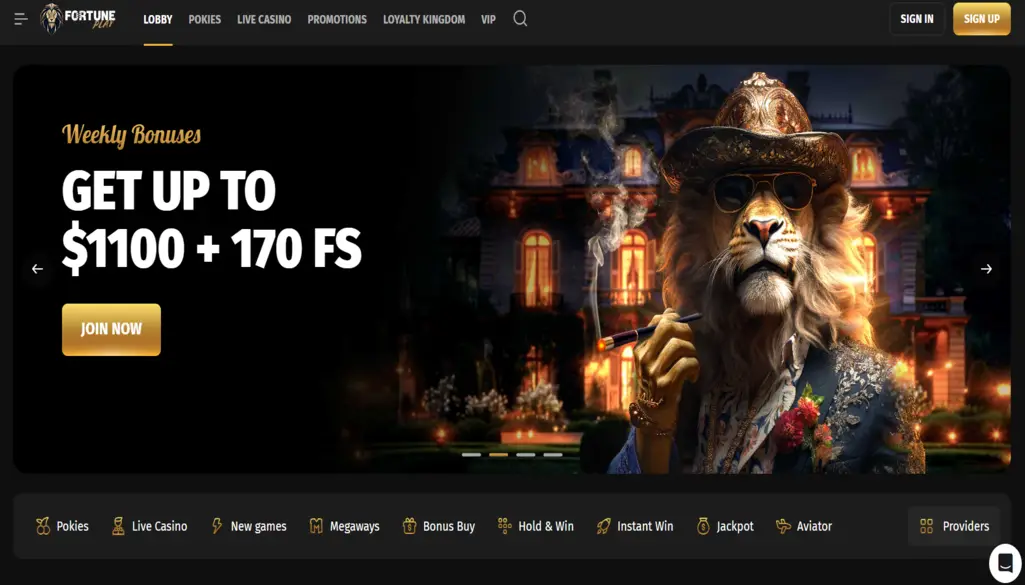
Game lobbies can look simple while presenting a great deal of information: categories, studios, formats, live tables and promotional labels. The Fortune Play catalogue is a useful example of why a structured reading method matters. Rather than choosing a title because it appears first or carries an appealing label, players can use the page layout to identify the type of game, its provider, the likely playing format and any conditions that may affect the experience. This approach supports clearer decisions without treating gambling as a source of income.
Start with the lobby structure, not the promotional labels
A game information page usually gives you several ways to narrow a large catalogue. The first layer is the broad category: Pokies/Slots, Jackpot, Bonus Buy, Megaways, Instant Win, Table Games or live casino. These headings describe the general format, but they do not tell you whether one game is more suitable than another. They are navigation tools, so use them to remove irrelevant choices before examining individual titles.
Collections can provide a second route. A lobby may group titles as new releases, popular games, exclusive content or themes such as mythology, fruit, books, Vikings and Asia. Themed collections are useful when presentation matters to you, while “new” and “popular” are simply sorting or merchandising choices. They should not be read as evidence that a title has better odds, lower risk or a greater chance of winning.
Search and provider filters are particularly helpful when you already know what you want to investigate. Searching for a title can avoid scrolling through thousands of entries, while selecting a studio can help you compare games made by the same developer. Remember that a displayed category is not necessarily permanent: the catalogue may change by market, provider restrictions or operator updates. If a title is missing, do not assume it has been removed everywhere.
What can a title card tell you?
An individual game tile commonly shows its name, image and provider, sometimes alongside a label such as “Hold & Win”, “Drops & Wins” or “Bonus Buy”. These details help identify the game’s broad mechanics and presentation. They do not, on their own, explain every rule. Treat the tile as an index entry rather than a complete game guide, especially when a label uses industry terminology that may not be familiar.
The provider name is useful for research within the lobby. It can reveal related titles and make comparisons easier, but it does not guarantee that every game from that studio follows the same design. A slot provider may offer games with different reels, bonus features, volatility profiles and published return figures. Likewise, a live table’s studio does not determine the result of a particular hand or spin.
Before committing funds, open the game’s information or help panel where available. Look for the paytable, symbol values, bonus-feature instructions, bet range, paylines or ways to win, and any stated return-to-player or volatility information. These details can vary between versions and markets. If the page does not clearly provide a figure or rule, do not fill the gap with assumptions based on another website or a similarly named title.
Separate game mechanics from claims about results
Game information explains how a title is designed, not what will happen during a session. A jackpot label may describe a prize structure, while “popular” may reflect usage or site placement. Neither tells you that a win is due, that losses will be recovered or that a game is more profitable. Even an attractive bonus round remains part of a random gambling product rather than a predictable opportunity.
Return-to-player, where published, is a long-run statistical measure rather than a promise for an individual player. It cannot predict the outcome of ten spins, one live hand or a single evening. Volatility is also a general description of how results may be distributed over time; it does not remove uncertainty. Short demonstrations or a few free rounds cannot verify either measure in a meaningful way.
Rules deserve the same caution. A feature described as a “buy” option, multiplier or progressive jackpot may have a separate cost, eligibility condition or contribution structure. Read the in-game instructions and the operator’s terms where relevant. For wider context on gambling information and safer choices, the New Zealand Department of Internal Affairs gambling information is a more suitable public reference than promotional commentary.
Compare slots and live tables on different terms
Slots are generally assessed through their visible mechanics: reel layout, paylines or win ways, symbol combinations, bonus features and any stated statistical information. Filters such as Megaways, Hold & Win or Instant Win can help you find a preferred format, but they are not interchangeable. Two games in the same category may still differ substantially in pace, complexity and how frequently prizes appear.
Live casino pages require a different reading method. Check whether you are viewing blackjack, roulette, baccarat, poker or a game show, then identify the table’s limits, rules and any special variations. Names such as Lightning Roulette or Crazy Time indicate a particular product format, not a general guarantee about results. A live table may also have different limits from another table offering the same broad game.
Separating these formats prevents misleading comparisons. A fast digital slot and a streamed roulette table do not present risk, speed or decision-making in the same way. Sports betting and esports products should also be treated as separate sections rather than extensions of the casino lobby. When comparing options, record the exact title, format, provider and displayed rules so that you are not accidentally comparing different versions.

Use the page as a decision checklist
A practical review can be completed in a few minutes. First, identify the game type and decide whether it matches what you intended to browse. Next, open the information panel and note the minimum and maximum stake, rules, feature descriptions and any published statistics. Then check whether the title is available in your market and whether the page shows a demo or information mode without implying that a demonstration predicts future outcomes.
It is also worth checking the surrounding account and promotion conditions before a game becomes connected to an offer. A title may be excluded from a promotion, or its contribution may differ from other games. The game page may not contain those terms, so consult the relevant promotion wording and account requirements. Do not assume that a game’s appearance in the lobby means it qualifies for every advertised reward.
- Identity: record the exact title and provider.
- Format: confirm whether it is a slot, table game, live table or another product.
- Rules: read the paytable, feature instructions and table conditions.
- Statistics: treat RTP and volatility as general information, not forecasts.
- Conditions: check market availability and any promotion restrictions.
Finally, decide whether the game fits your time and spending boundaries before opening it. If the information is incomplete, pause and ask support for clarification rather than relying on a forum or a similarly named title. Clear navigation is valuable because it reduces confusion; it does not make an uncertain outcome more controllable.
Questions readers often ask about game pages
Does a popular or new game have better odds?
No. “Popular”, “new” and similar labels mainly help organise or promote the catalogue. They do not establish that a title has a higher return, lower volatility or better chance of winning. Compare the published rules and statistics instead, while remembering that statistical information cannot predict a particular session.
Why might a game appear in one lobby but not another?
Availability can vary because of market restrictions, provider rules, catalogue updates or technical changes. A title’s presence in one category does not guarantee that it is available to every account or region. Check the current lobby and the operator’s stated requirements rather than relying on an older listing.
Can a short demo prove how a game performs?
No. A short demonstration can show the interface and basic mechanics, but it cannot verify long-run statistical behaviour or predict future results. Use it only to understand navigation and features. If the title’s rules, costs or published information remain unclear, seek clarification before making a decision.